

The first step in entering a public cloud will be creating the initial construct, which is mostly referred to as a subscription created in the name of your organisation regardless of the size of your organisation or regardless of the cloud provider.
A subscription bounds your organisation’s business email, company name, pricing tier, support level and payment method with normally a monthly recurring billing arrangement until you decide to cancel it.
Startup
This model normally provides free credit to be used with the first subscription and does not limit the usage, hence this model is normally well adopted by R&D institutions and startups.

For startups, the critical factor would be the budget more than anything, so the first thing or first guardrail for any startup is to set up a budget before starting using any cloud subscriptions. You need to be mindful as normally the budget is only updated once a day so spending within a day will have to wait for the next day to understand burnout on the budget.
All the public cloud providers have this subscription construct or account available with free credits to motivate their cloud adoption among developers and startups. On top of this, some cloud providers also provide additional credits for eligible startups case by case based on the startup scenario.
Small business
For small businesses, the scenario will be added complexity compared to the startup scenario as small businesses normally would have applications running on-premise or on office computers unless they are completely paper-based!
From the surface, it almost looks like a startup scenario, but it’s way more complicated to manage than a startup scenario, which unfortunately most people realise only after migrating one or two workloads into the cloud.
Managing workloads in the cloud is completely different from managing workloads on-premise from skillsets, cost, provisioning and risk. For small businesses, their IT, finance and security will mostly have one and best chance two in each area.
So ideally all those people need to be upskilled and be prepared to take up new workloads in the cloud otherwise after migrating one workload they all will end up spending most of their time managing one or two workloads in the cloud.
It’s worth considering your business outcome and do a SWOT analysis based on doing the same thing on-premise vs cloud to understand where you have more likely to get closer to your business outcome.
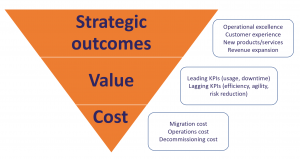
Cloud is promoted more for speed and agility, it’s only effective if you can sustain all support aspects on the cloud together with everything else you have on-premise. So be very clear about your business outcome and see whether cloud migration is going to get you the business outcome that you desire, do NOT expect your desired business outcome just by moving in to cloud.
Enterprise
You can imagine an enterprise as a collection of multiple small businesses based on a product or value stream, yet IT, finance and security are centrally managed to drive standardisation and cost-efficiency. Although it’s an understatement you can now clearly see the order of magnitude in terms of complexity in migrating even a single enterprise workload in to cloud compared to a small business.
But regardless of whether it’s a small business or large enterprise, everything that we do including cloud migration MUST be aligned towards the desired business outcome. This is easily said than achieving it, as includes so many factors and a very good macro-level understanding of the big picture across technology including cloud, finance, operations and market proposition.
The CEO would have nominated CTO, CFO, COO and CMO to drive the business outcome and steer the company in the strategic direction. Once it’s get translated into each of these CXO roles, they will start looking at their own area and it’s very common from there each one of them may start driving outcomes that they think will help the overall business and strategic outcome of the company, not necessarily all aligned to each other.
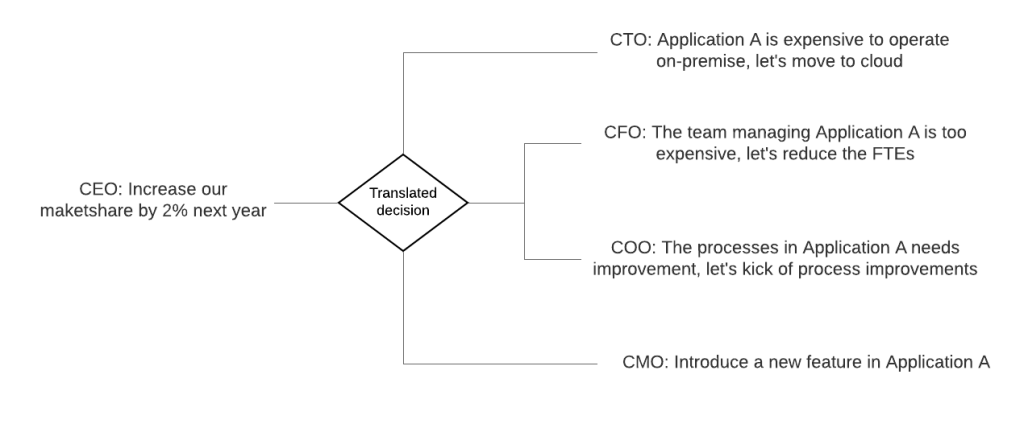
At Enterprise-scale, it’s required a clear strategy on how you want to set up your Public Cloud subscription. The same is expected to be any Public Cloud offerings to provide the construct that can manage all these different viewpoints and still make sure the overall outcome is managed so that is always aligned.
The enterprise demands centralised management and dashboard view of cost, technology and application footprint, operational and governance and last but not least the entire product portfolio and significant features visible across your Cloud deployment.
This was so hard to achieve even for major Public Cloud providers like Amazon and Microsoft took several years to get to where they are now as of the time of writing this blog. Google is slowly getting there to support enterprise-level organisation structure and the rest are still far behind.
This is to just highlight the fact that enterprise adoption of Public Cloud is not only evolving within enterprises but also the cloud providers rapidly introducing new constructs and features to fast track it.
The Public Cloud construct for enterprises and enterprise cloud strategy are their own separate topics and will be covered by other blogs posts.
 Designed 4 Cloud Limited